

In 2026, 80% of sales teams miss their forecasts by over 10%, leading to stalled hiring, slashed budgets, and unreliable cash flow predictions. The solution? Moving beyond outdated, manual forecasting methods and embracing data-driven, AI-powered predictive models. These models analyze real-time buyer signals, sales velocity, and historical trends to deliver accuracy rates as high as 96%.
Key Takeaways:
- Traditional forecasting relies on gut feelings and static CRM data, with accuracy rates of only 50–70%.
- Predictive forecasting uses AI and machine learning for real-time updates, achieving 85–96% accuracy.
- Methods like time-series analysis, pipeline-based forecasting, and AI-driven models cater to different sales cycles and complexities.
- Tools like Teamgate CRM ensure clean data, automate workflows, and provide actionable insights to improve forecasting precision.
Why it matters: Accurate forecasting isn’t just about hitting numbers – it’s about building trust, planning confidently, and staying ahead in unpredictable markets. Teamgate helps sales teams follow a clear process and trust their forecasts – without turning CRM into an admin burden.
How to Use AI to Accurately Call Your Sales Forecast
sbb-itb-5772723
Core Predictive Forecasting Methods for Sales Teams
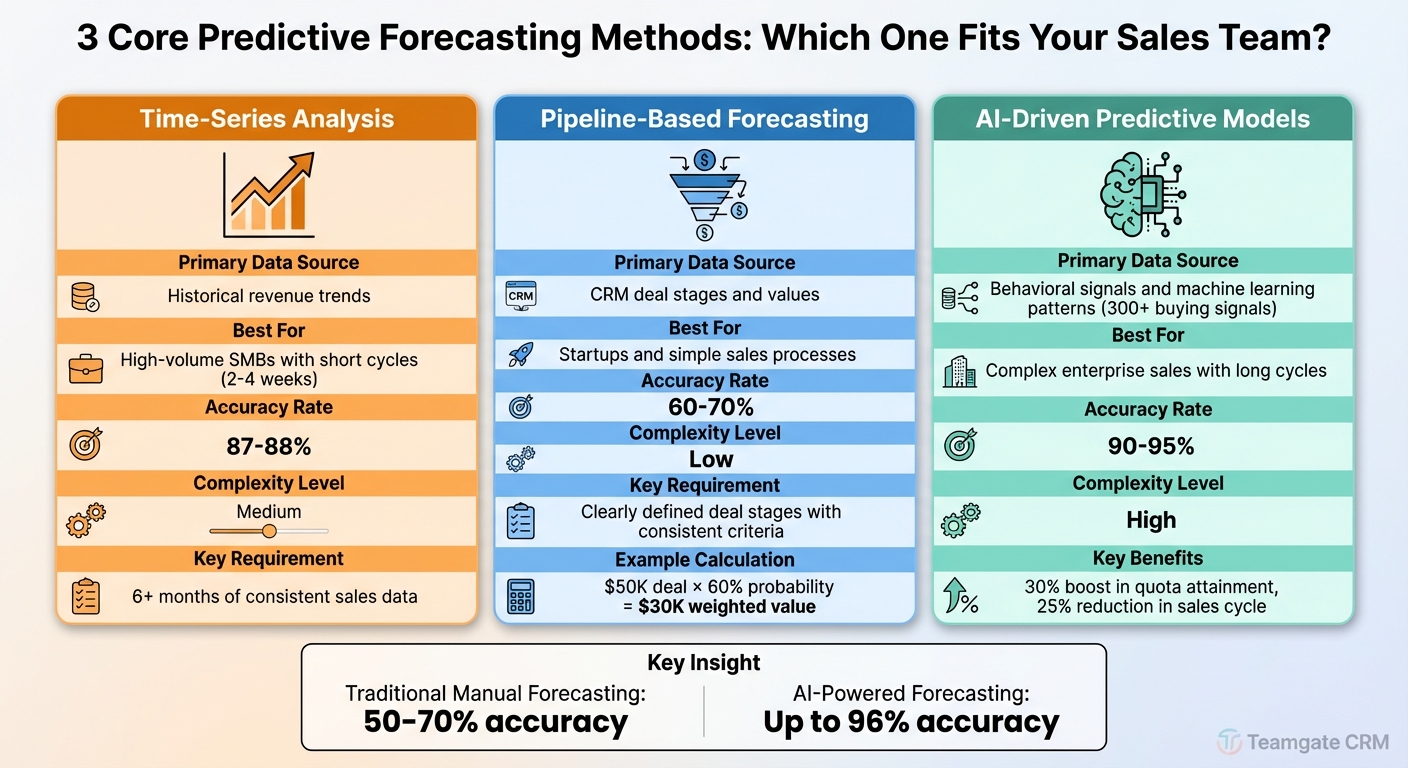
Sales Forecasting Methods Comparison: Accuracy and Best Use Cases
By 2026, three key methods are shaping how sales teams forecast revenue, each suited to different business models and data sources. Choosing the right approach – or combining them effectively – can mean the difference between hitting your revenue targets and falling short. Here’s a breakdown of these methods, starting with time-series analysis.
Time-Series Analysis for Revenue Patterns
Time-series analysis focuses on identifying patterns in historical revenue data – whether weekly, monthly, or quarterly. It’s particularly useful for spotting seasonality and growth trends, making it ideal for SMBs with high sales volume and short, predictable cycles. For example, SMB sales teams operating on 2–4 week cycles can achieve forecast accuracy rates of 87–88% using this method.
However, this approach works best when there’s at least six months of consistent sales data to analyze. Early-stage startups may struggle to apply time-series analysis effectively until they’ve built a reliable baseline. For businesses looking to incorporate current deal activity into their forecasts, pipeline-based forecasting is a logical next step.
Pipeline-Based Forecasting Using Deal Stages
Pipeline-based forecasting estimates future revenue by analyzing active deals in your CRM and assigning probabilities based on their current stage. The weighted pipeline formula multiplies each deal’s value by its stage-specific probability, then adds up the results. For instance:
- A $50,000 deal at 60% probability contributes $30,000.
- A $100,000 deal at 80% probability adds $80,000.
This method works best when deal stages are clearly defined with consistent entry and exit criteria. For example, every team member should follow the same rules for moving deals from Discovery to Proposal.
Pipeline forecasting’s accuracy depends heavily on maintaining clean data. Stale close dates, inflated deal values, or outdated opportunities can throw off projections. Weekly pipeline audits are essential to keep your CRM data reliable. For even more precision, consider incorporating AI-driven predictive models.
AI-Driven Predictive Models
AI forecasting uses machine learning to analyze a wide range of data points, including deal characteristics, buyer engagement, email activity, meeting attendance, and win/loss history. Unlike static stage probabilities, AI assigns dynamic confidence scores that update in real time as buyer behavior changes.
This method excels in complex enterprise sales environments with long cycles and multiple stakeholders. AI models can achieve accuracy rates of 90–95% for short-term forecasts, far outperforming traditional manual methods, which typically hover between 60–70%. Companies using AI forecasting have reported a 30% boost in quota attainment and a 25% reduction in sales cycle length.
AI also helps identify at-risk deals early by flagging indicators like reduced buyer engagement or lack of executive involvement. However, successful CRM implementation and clean data are critical – any inaccuracies can be amplified by the AI. To build trust in the model, run AI forecasting alongside traditional methods for at least one quarter before fully transitioning.
Comparison of Forecasting Methods
| Feature | Time-Series Analysis | Pipeline-Based Forecasting | AI-Driven Predictive Models |
|---|---|---|---|
| Primary Data Source | Historical revenue trends | CRM deal stages/values | Behavioral signals & ML patterns |
| Best For | High-volume SMBs | Startups/Simple sales | Complex Enterprise sales |
| Accuracy | 87–88% (for short cycles) | 60–70% | 90–95% |
| Complexity | Medium | Low | High |
Each method has its strengths and is tailored to specific sales scenarios. Using a combination of these approaches can provide a more comprehensive and reliable forecast, ensuring your team is better prepared to meet revenue goals.
Using Teamgate CRM for Predictive Sales Forecasting
For predictive sales forecasting to work, your CRM data needs to be accurate and up-to-date. Problems like outdated deals, missing next steps, and incorrect close dates can throw off your forecasts entirely. Teamgate CRM is designed to tackle these issues head-on by ensuring clean pipelines and consistent follow-up are part of your daily workflow, not an extra chore.
Teamgate combines advanced forecasting tools with a system that prioritizes data accuracy. It focuses on three key features to keep your forecasts reliable: visual deal management to ensure every opportunity is properly tracked, workflow automations to reduce manual updates, and sales dashboards that provide real-time insights into critical metrics like deal activity and next steps. These tools work together to transform your CRM from a static database into a dynamic tool for accurate forecasting.
Clean Pipelines with Visual Deal Management
Teamgate’s visual pipeline ensures that every deal is properly staged and has a clear next step. This eliminates inactive deals that inflate your pipeline and distort your forecasts. For example, when a deal moves from Qualified Leads to Proposal, the system prompts the rep to define the next action – such as scheduling a demo or sending pricing details.
With customizable pipelines, you can set specific criteria for each stage. For instance, you might require a logged discovery call and a confirmed budget before a deal moves to the Proposal stage. This structured approach ensures everyone follows the same process, making your data more reliable for predictive models.
Workflow Automations for Data Accuracy
Teamgate automates routine tasks to save reps time and keep your data current. For instance, you can set up triggers to automatically create follow-up tasks when proposals are sent, adjust close dates when deals advance, or send reminders if a deal remains in the same stage for too long.
"The key wasn’t better discipline: it was eliminating the friction between where sellers work and where forecasts get built."
- Maria Akhter, Editor, Outreach
Automated systems like these can reduce forecasting errors by 20–30%. By removing delays between actions (like sending a proposal) and updates to your CRM, automation ensures your forecasting models – whether AI-driven or traditional – are always working with the most current data.
Sales Dashboards for Real-Time Visibility
Teamgate’s real-time dashboards turn clean data into actionable insights. Managers can monitor key metrics like deal age, activity levels, and next-step coverage to stay ahead of potential issues. For example, if a high-value deal has been stuck in Negotiation for 21 days without activity, the dashboard flags it as a risk, giving you a chance to intervene before it’s too late.
These dashboards also support scenario planning, which is vital for accurate forecasting. You can filter your pipeline by stage, probability, or close date to model different outcomes. For instance, you can explore scenarios like, "What if only deals with a 70% probability close this quarter?" or "What happens if the largest deals in Negotiation fall through?" This flexibility gives leadership a clearer picture of potential revenue outcomes and risks.
Teamgate helps you maintain clean, actionable data while simplifying forecasting through automation and real-time insights, making it an essential tool for sales teams aiming for accuracy and efficiency.
Adding AI-Driven Forecasting to Teamgate CRM
Teamgate CRM introduces AI-powered forecasting to bring precision and objectivity to sales predictions. By analyzing patterns that might escape human attention, AI replaces guesswork and intuition with data-driven insights. It evaluates factors like stakeholder engagement, deal speed, and historical success rates to forecast outcomes more reliably.
"AI removes the human bias and ‘happy ears’ that plague traditional forecasting. Instead of relying on a sales rep’s optimism, the system analyzes objective data signals to determine a deal’s true health."
- Nathan Thompson, Fullcast
With AI-driven forecasting, accuracy can reach as high as 96%, compared to just 51% for manual methods. Teamgate CRM applies this technology in three key areas to help sales teams improve their processes right away: lead scoring to prioritize deals, activity tracking for real-time adjustments, and forecast accuracy measurement for continuous improvement.
Using Lead Scoring to Focus on High-Probability Deals
Teamgate’s lead scoring system evaluates opportunities based on their likelihood to close, using buyer engagement as a key factor. For instance, deals involving multiple stakeholders in meaningful interactions are ranked higher than those with limited contact.
This distinction between "activity" (just doing tasks) and "progress" (making meaningful headway) is crucial. Well-qualified deals are 6.3 times more likely to close than poorly qualified ones. By focusing on high-scoring deals, sales teams using AI-powered scoring can achieve 45% higher win rates. In Teamgate, these high-priority opportunities are highlighted automatically, allowing reps to channel their efforts where they’re most likely to succeed.
Tracking Activity Signals for Dynamic Forecasts
Teamgate monitors over 300 buying signals – like email response times, meeting participation, stakeholder involvement, and even conversation tone – to adjust deal probabilities in real time. If a previously engaged stakeholder suddenly goes silent or a competitor is mentioned during discussions, the system flags the deal as at risk before it fully stalls.
This approach improves forecast precision by 20% compared to models relying solely on CRM data.
"Our forecasting is purely AI based on behaviors that someone’s manifesting on how they manage a pipeline or mismanage a pipeline."
- Craig Daly, CRO at Nectar
Teamgate’s AI doesn’t wait for manual updates. It automatically detects when deal momentum slows – like when a proposal isn’t opened or a key milestone is missed – and adjusts forecasts accordingly. The system also differentiates between mere "motion" (logging calls or meetings) and meaningful "progress" (building strong buyer relationships). Deals stuck in negotiation with minimal engagement are flagged, giving managers the chance to intervene early.
Measuring and Reporting Forecast Accuracy
Teamgate’s reporting tools provide ongoing insights into forecast reliability. You can compare predicted revenue against actual outcomes, spot patterns in missed targets, and refine forecasting models over time.
"Our forecast accuracy has grown to the point that we’re now at 95%. Gong lets us run a predictable revenue organization… and save tons of time on forecasting."
- Drew Korab, Director of RevOps at Upwork
Similar to Gong, Teamgate offers real-time variance analysis and "what-if" scenario planning. These tools allow leadership to adjust strategies before the quarter ends. For example, you can filter deals by AI-confidence scores to focus on conservative revenue projections or isolate high-confidence deals to understand your revenue floor. This flexibility enables data-backed decisions about hiring, budgeting, and pipeline investments, ensuring your team stays ahead of the curve.
Best Practices for Accurate Sales Forecasting in 2026
To achieve precise sales forecasting, top-performing teams combine multiple data sources, account for uncertainty, and rigorously track performance. Teams that consistently stay within ±5% of their forecasts rely on disciplined methods that blend historical data with real-time pipeline insights.
Combining Pipeline and Time-Series Models
Relying on a single forecasting method often limits accuracy. Instead, hybrid models combine current pipeline data with historical revenue trends to produce more reliable predictions. For example, short-cycle SMB sales often achieve 87–88% accuracy using time-series models, while enterprise deals benefit from integrating pipeline probabilities and engagement signals.
A practical case is Siemens, which in December 2025 implemented a unified forecasting system for 4,000 sellers across 190 countries. By connecting CRM data to historical analytics instead of using fragmented spreadsheets, they achieved 70% submission rates and global transparency. Similarly, RUCKUS Networks integrated conversation intelligence with CRM forecasting, saving an estimated $2M annually while improving accuracy with customer interaction data. To streamline the integration of data across systems, many teams rely on Integrate.io, a low-code data integration platform that connects CRM, historical analytics, and other data sources without heavy engineering.
Choosing the right model depends on your sales cycle and deal complexity. Time-series models work well for short-cycle deals, while pipeline-based forecasting is better suited for long-cycle enterprise opportunities. Behavioral signals, like quota attainment and commission accelerators, can also provide insights into how human factors impact deal movement.
"A forecast is not a guarantee. It is a probabilistic estimate designed to guide decisions. The goal is not perfection but sales forecast accuracy that is consistent, explainable, and improvable over time."
- Alex Zlotko, CEO at Forecastio
Once hybrid models are in place, companies should prepare for market fluctuations through scenario planning.
Scenario Planning for Different Market Conditions
Forecasting isn’t just about predicting a single outcome; it’s about preparing for variability. Scenario planning involves modeling multiple potential outcomes based on factors like win rates, deal velocity, and market trends. Businesses that excel at this approach are 20% more likely to outperform competitors during disruptions.
Develop three to five scenarios to balance insight with decisiveness. These might include:
- Expected Case: A baseline forecast based on current pipeline health.
- Best Case: An optimistic yet realistic scenario, such as a 15% boost in win rates from a new product launch.
- Worst Case: A downside scenario, like a 20–30% drop in win rates due to economic challenges or competitor actions.
Qualtrics offers a strong example of scenario planning. By integrating AI forecasting with GTM planning, they eliminated manual processes and created a unified system of record for revenue. This setup allowed them to run "what-if" analyses instantly, testing the impact of changes like offering discounts or reallocating top-performing reps to strategic deals.
"Scenario planning transforms reactive firefighting into strategic decision-making: creating multiple forecast pathways that prepare your organization for different futures rather than hoping for a single one."
- Andi Dominguez, Sr Manager, Product Marketing, Outreach
Clearly document the assumptions behind each scenario. For instance, a "Best Case" might assume win rates rise from 28% to 34% due to a successful Q1 pilot. Establish trigger-based action plans – like pausing hiring if pipeline coverage falls below 3x – and review scenarios quarterly to stay aligned with changing conditions.
Tracking Accuracy Metrics for Continuous Improvement
Accurate forecasting requires consistent measurement. Top-performing teams hit forecasts within ±5%, while average teams miss by 15% or more. The difference lies in tracking key metrics and using them to refine processes.
- Mean Absolute Percentage Error (MAPE): Tracks average error across periods, ideal for long-term trends.
- Weighted Absolute Percentage Error (WAPE): Adjusts for deal size, making it suitable for team roll-ups.
- Forecast Bias: Identifies whether reps tend to over-forecast (optimism) or under-forecast (sandbagging).
| Performance Level | Variance Range | Characteristics |
|---|---|---|
| Elite | ±5% | Tight commit criteria; weekly inspection; clean hygiene |
| Good | ±10% | Clear processes; regular reviews; decent data quality |
| Average | ±15% | Frequent misses; inconsistent methods; weak qualification |
| Poor | >±15% | Messy CRM data; sandbagging or wild optimism; no process |
Break down accuracy by category:
- Commit deals should close at 90–95%.
- Best Case deals should close at 50–70%.
- Pipeline deals should close at 20–30%.
If your commit rate falls short, it may signal loose qualification standards. Companies that regularly review and act on forecast accuracy metrics see 15% higher sales performance on average.
Maintaining CRM hygiene is also crucial. Missing fields, outdated close dates, or deals with no next steps can derail accuracy. Replace long pipeline reviews with short, focused weekly "commit inspection" calls. Use historical error rates to adjust future forecasts; for example, if your team consistently over-forecasts by 15%, apply a 0.85 multiplier to predictions.
"When the CFO asks ‘What are we closing this quarter?’ and you’re off by 20%, that’s not a forecasting problem. That’s a credibility problem."
- Tara Minh, Operation Enthusiast
Conclusion: Building a Predictive Sales Process with Teamgate CRM
Key Takeaways for Sales Teams
Accurate forecasting is the backbone of a reliable sales process. It transforms your pipeline into a dependable tool for planning and decision-making. Shifting from instinct-based forecasting to a data-driven approach can significantly improve outcomes. Companies using AI-driven sales forecasting report 15-20% better forecast accuracy and 25% shorter sales cycles. Additionally, businesses with clear pipeline visibility see 15% higher revenue growth and 18% higher profit margins.
The process starts with clean and reliable pipeline data. By ensuring structured deal stages with clear exit criteria and automating data capture for interactions, you eliminate much of the guesswork that inflates forecasts – an issue affecting roughly 80% of companies. Combining time-series analysis, AI-driven insights, and pipeline-based models gives teams a well-rounded approach. Adding behavioral signals like email response times or stakeholder involvement allows you to transition from reactive problem-solving to proactive revenue management.
While technology brings precision, human insight remains essential. For example, models may overlook details like a key contact leaving the company or shifting buyer priorities. The best-performing teams let AI handle the heavy data lifting, enabling leaders to focus on strategy and coaching.
"A forecast is not a guarantee. It is a probabilistic estimate designed to guide decisions."
- Alex Zlotko, CEO at Forecastio
Next Steps for Better Forecasting
To improve forecasting, start by analyzing your current process. Identify gaps such as deals without next steps, delays in manual data entry, or low forecast submission rates (below 70%). These weak points highlight areas where Teamgate CRM can deliver the most value.
Teamgate CRM simplifies forecasting with tools that enforce structured selling while reducing administrative work. Its visual pipelines with custom stages ensure every deal has a clear next step. Workflow automations sync emails, calls, and meetings automatically, eliminating manual data entry. Sales reports and dashboards highlight critical metrics like deal age, activity coverage, and next-step clarity, ensuring pipeline reviews are based on evidence rather than assumptions. Lead scoring prioritizes high-probability deals, while forecasting tools help filter meaningful insights from distractions.
The path forward is clear: unify your sales data, standardize your pipeline, and establish a consistent forecasting routine. Businesses that centralize their data see an average 299% ROI over three years, and well-qualified deals are 6.3 times more likely to close successfully. With Teamgate CRM managing the essentials – accurate data, consistent follow-ups, and real-time insights – your team can focus on building relationships, progressing deals, and making informed, strategic decisions. By aligning your approach with these strategies, you can drive steady revenue growth.
FAQs
How do I pick the right forecasting method for my sales cycle?
To select the best forecasting method, start by assessing the complexity and length of your sales cycle, along with the level of accuracy you need. For short, straightforward sales cycles, methods like activity-based or opportunity-based forecasting are often effective. If your sales process is longer and involves multiple steps, approaches such as regression analysis, historical trend analysis, or AI-powered forecasting might be more suitable. Consider factors like the complexity of your deals, the quality of your data, and the precision you require to ensure the forecasting method supports your process and aligns with your strategic objectives.
What CRM data must be clean for AI forecasting to work?
For AI forecasting to deliver reliable results, your CRM data needs to be clean, complete, and regularly updated. Critical fields such as deal stages, close dates, deal values, and customer details must be accurate and free from errors or duplicates. By maintaining strong data hygiene – correcting mistakes and addressing gaps – you enable AI models to identify patterns more effectively. This leads to better forecast accuracy and supports smarter, data-driven decisions.
How do I measure and improve forecast accuracy over time?
To get better at forecasting accuracy, start by tracking forecast deviation – the difference between predicted revenue and actual results. Look for recurring patterns of over- or under-estimation and refine your models accordingly. Establish clear processes, such as structured governance, evidence-based commitments, and regular reviews, to minimize biases in your forecasts. Using AI-driven tools like predictive deal scoring can also sharpen accuracy by identifying risks and validating progress, ensuring your forecasts are grounded in reliable, data-backed insights.