Get a free sales audit to uncover hidden revenue opportunities!

Every team is important, but your sales reps are under a lot of pressure to convert your leads into customers. Without your sales reps, your business is in real trouble. So it’s important to make sure they’re operating at the peak of their potential by monitoring their performance.

There are many articles out there that focus on monitoring the performance of your sales reps, but we believe that employees are entitled to trust and privacy from their employer.

How do you balance their need for privacy while collecting the necessary data to analyze performance?

Introduction to workplace privacy

You’ve hired your staff because you believe they’re the best people for the job. Don’t insult them by monitoring every single interaction they have with your clients or customers.

In some instances, such as for legal reasons, strict monitoring of all employee communications is advised. But for the purposes of improving sales performance, you should focus on the sales data rather than private correspondence.

Effective monitoring yields result for both employees and employers. It’s motivating for staff because it highlights the areas where your reps are doing well, and also shows them objectively where they can improve.

Firsthand experience

As the CEO of your company, it’s essential for you to know what your staff is up to, without infringing on their privacy.

With the best of intentions, staying in the ivory tower can’t provide you with reliable insight into your team’s performance. Data should be combined with personal observation to generate well-rounded results. Spending a day with your team gives you a direct experience of their frontline work, and also makes them feel valued.

Sales Reps Performance vs Privacy Tracking

For example, you may have one team member who isn’t performing as well as the others. If you only look at the data, you might see them as the underdog. Direct observation shows you they’re picking up the slack for the rest of the team by providing day-to-day customer service.

This kind of insight can suggest that you may need to hire a receptionist or an admin assistant to deal with your clients’ general inquiries. You’re using data and observation to support your sales reps.

Using a sales CRM for your team

Monitoring your employees with analytics is not about singling out individual team members but viewing their performance in light of the whole team. Rather than spying on your staff, you can use a CRM tool to work for your team by providing a 3D picture of their sales.

A sales CRM is a valuable tool for collecting the necessary data about your team’s activities. All sales activities are recorded in the CRM for anyone to refer back to.

More than just a CRM, Teamgate is a complete sales stack for your team. It offers the capability for you to generate objective data to improve your future sales strategy. It also helps you forecast your future sales income, over the next month and for all-time. It’s easier to turn leads into customers with a handy sales funnel.

Monitoring sales insights

No one wants to trawl through boring reports, especially high-pressure sales reps who have their eye on making their next commission.

With a CRM like Teamgate to manage your sales activities, your reps are relieved of the need to keep manual records. All of your data is centralized in one place and can be easily imported or exported.
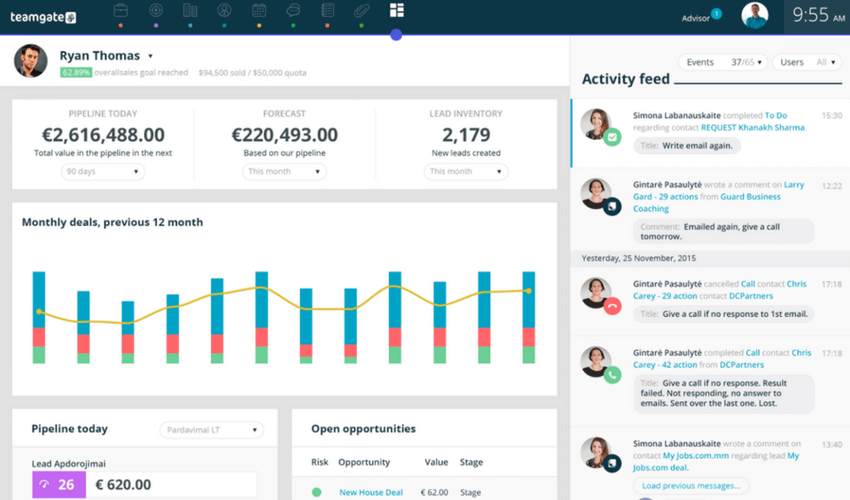
Sales Reps Performance vs Privacy Teamgate Analytics

Teamgate CRM offers intelligent, actionable insights into your sales activity that can tell you where you could improve your operations. For example, Pipeline Trajectory tells your reps when they should reach out to leads with a specific action, meaning no more guesswork.

The goal is to accurately monitor your sales insights without targeting individual employees. You’ll uncover problems with your sales strategy if it turns out lots of reps are having difficulties in the same area.

Using your data to reward sales reps

It’s not about punishing your employees when things go wrong, but rewarding their efforts when they do well.

Highlight the achievements of your reps with a monthly ‘Sales Star’ award. This positively reinforces your employees’ behaviour and motivates them to continue.

You can even set up sales goals in Teamgate so that your team is automatically motivated every day. They can even compare their results with their colleagues in friendly competition.

Making the most of the sales calls

Phone calls are a channel that is especially prone to losing valuable data. If no one records interaction with your potential customer, you may lose them at a critical point in their journey.

Teamgate SmartDialer is the dialling system you’ve been waiting for to take a headache out of calls.

Teamgate SmartDialer features:

  • Integrates with our sales CRM so you can access your customer data and easily manage relationships.
  • Enables you to make calls directly from Teamgate in the browser for maximum efficiency and user experience.
  • Records conversations so reps can review their calls at a later date. This ensures that nothing valuable is lost in the unpredictable environment of a busy modern workplace.
  • Connects your sales reps with their prospects so incoming phone calls are routed to the right person, every time. Your prospects will be impressed with their personalized experience and pleased that they weren’t accidentally passed between team members like a hockey puck.

Takeaways

Sales reps use their personalities and powers of persuasion to demonstrate to prospective customers exactly why your products would benefit them. They work on the frontline in a stressful environment and face constant rejection. Don’t make their jobs harder for them by monitoring your staff like Big Brother.

Sales Reps Performance vs Privacy Goal Setting

Always assume your sales people are doing the best they can with the resources you’ve given them. If there’s room for improvement, and there always is, smart CEOs know they can usually change their processes to empower their staff.

As a CEO, you can work together with your reps to make their lives easier. Provide them with actionable insights on their performance based on real data. Teamgate offers the perfect blend of sales metrics and automates mundane tasks, without compromising the privacy and independence of your sales team.

Leadership and leader skills – we hear these terms in every job interview and description. You might think that leadership questions are relevant only for managers but that’s not true. Most companies are looking for people with leadership potential even, for entry-level positions. In particular, small businesses and startups – they need leaders more than any other business to create and motivate a team in a hectic environment.

The biggest confusion remains with the term ‘leadership’ – what exactly does leader mean and what skills should a leader have? If we delve deeper into the term ‘leader’ we will discover that it covers much more than just a ‘personality trait’.  The newest findings in neuroscience help us to understand how the brain works and how it can help control mental processes in order to become a better leader. We’ve teamed up with Claire James, the Managing Director of Pivotal Moment Transitions who talked us through internal mechanisms of a leader from the neuroscientific point of view. Below you’ll find an overview concerning the subjects of good and bad leadership and what you can do to take your own leadership skills to the next level. You will also gain an insight into why great leadership skills are some of the most sought after in every facet of modern business.

1) How would you define a great leader?

It’s a funny old thing, whilst there is considerable and often common consensus on what makes a bad leader, there’s usually less agreement on what makes a good one.  This may be because each of us has our own individual style of leadership; each with strengths and weaknesses and areas for personal development.  Therefore, some contexts and organisational structures or cultures may suit one type of individual leader, whilst others do not.

However, there appears to be some personality types which are currently over-represented at leadership level than they are in the general population.  For example, Oxford University Press – UK specialists in the Myers Briggs Type Indicator (MBTI®), a psychometric assessment based on the theories of renowned psychologist Carl Jung – contains some interesting data on the subject.

Do you have a CRM that keeps you organised?

The most user-friendly CRM on the market. 14-day free trial.

Start Free Trial

Painless setup, no credit card required

Their research shows that if you tend to make decisions based on logic, rather than values or feelings (what’s known as a ‘Thinking’, rather than a ‘Feeling’ preference), and are more planful than emergent in how you like to organise yourself and the world around you (known as a ‘Judging’ rather than a ‘Perceiving’ preference), then you will find a larger proportion of people with these same preferences in management roles, than is representative of the population in general.

This may well be the legacy of a command and control style of leadership, combined with the tendency for leaders to recruit in their own image. It will be interesting to see how this changes as fresh generations come through the ranks.  ‘Millennials’, for example, appear to be much more interested in the concept of ‘purpose’ in their jobs than purely money or status. They are also less likely to accept dysfunctional behaviour by a manager or leader which a 1970’s youth may have seen as par for the course.

2) Why do companies need leaders?

Interestingly, there are already new breeds of organisational structures emerging which do not appear to need leaders in the traditionally recognised sense. Power in varying degrees (whether in relation to strategy and vision, or more basic decisions; such as sundry purchases) is distributed throughout the organisation.

These organisations operate without the requirement of a central control system. Instead, individual cells (individuals and teams) flex, transform and grow in response to the context in which they find themselves; constantly adapting in small, incremental ways to find the best route to surviving and thriving.  In fact, this is also how ‘neuroplasticity’ – or changes in the brain’s wiring – works. For more on this and how some of the world’s most successful organisations are choosing this approach take a look at the work of Frederic Laloux and his book ‘Reinventing Organisations’.

3)  Do you believe that some people are ‘born leaders’, or is leadership a trait which can be taught or learned?

I believe (and neuroscience would also suggest), that the answer is a combination of both; and then some!  We know that whilst some behaviours are strongly affected by inherited genetics and neural patterns created through our upbringing, we can also learn to adapt and to ‘upskill’ through awareness and a willingness to ‘take a chance’, putting new approaches into practice.

Again, context is important. There will always be some who are more comfortable taking the lead in certain situations than others. What I think is most critical is that people be given the leeway to lead in a manner which feels ‘right’ for them and who they are; whilst staying authentic, or true to themselves.

neuroscience behind the leadership

In my own career I have known leaders with vastly different styles who have managed to be equally effective at inspiring those around them to attain their highest level of performance. I believe that leaders who are most effective are those who find their own individual style, and who are also open to others finding their own style, however different that may be.

Neuroscience demonstrates that for any kind of personal growth and learning, awareness of patterns is key. That’s why, at Pivotal Moment, when we are working with leaders. We use psychometric assessments like the MBTI®, the Enneagram, or the Hogan ‘Bright Side’, ‘Dark Side’ and ‘Inside’. These all get to the heart of neurological and behavioural patterns that are inherited or that have developed through our early life experiences, enabling us to identify where they show up and how they serve us or get in the way. We can then use awareness to focus on new ways of being and doing as leaders.

At Pivotal Moment, we specialise in harnessing the ways in which the brain most easily makes sustainable change. We include in our portfolio of leadership coaching programmes, the Marshall Goldsmith Stakeholder Centered Coaching for guaranteed and measurable leadership growth. Marshall Goldsmith has been recognised multiple times as the world’s No 1 Coach and has been acknowledged as the World’s No 1 Leadership Thinker by Harvard Business Review. His coaching system taps into the power of stakeholder support to assist a leader in growing in 1 to 2 key leadership areas over the course of a year to 18 months. This process has developed hundreds of the world’s top leaders across 5 continents. It comes with a ‘No growth, no fee’ guarantee.

4) Do you think it’s harder to be a female leader of the company and how can that be changed? (A lot of women working in tech’ and startup companies are still finding it very difficult to be taken seriously)

Again, the MBTI® research shows that many more women report a preference for ‘Feeling’, rather than ‘Thinking’; 76% v 24%.  In men, they found a split of 56% ‘Thinking’, 44% ‘Feeling’. Given what we noted earlier about those with a preference for ‘Thinking’ being over-represented at management level, and people tending to recruit in their own ‘psychological image’, this may in part explain the difficulties that women experience in rising to the leadership level.

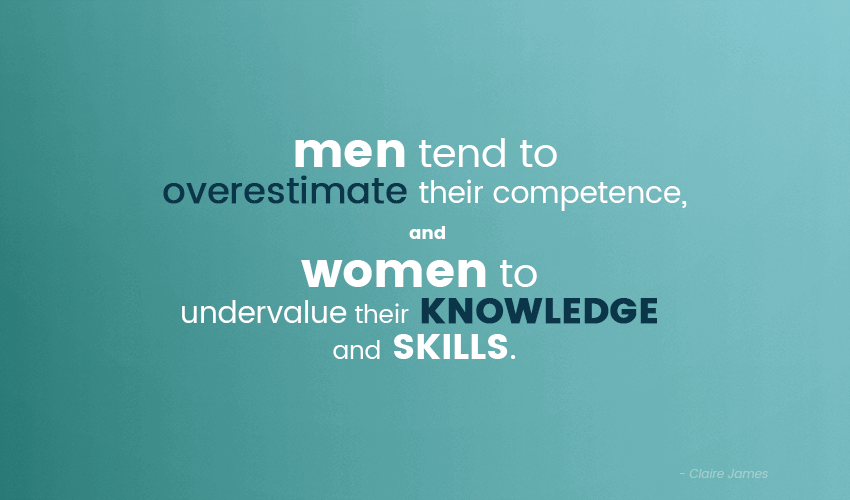
Other studies have shown that there is a significant confidence gap between men and women; men tend to overestimate their competence, and women to undervalue their knowledge and skills. A study in London in 2012 also identified that women are not sponsored by senior leadership in the same way as men. Men were found to be better at promoting themselves and their achievements and to at using networking and the power of a sponsor to climb the corporate ladder.

Women were found to play what’s termed ‘Secret Cinderella’, i.e. “If I do a great job, the prince will surely turn up on my doorstep and try my foot in the glass slipper of senior management!”. Sadly, in cultures where you are expected to self-promote and shout your wins from the rooftops, these ‘Cinder’s’ often remain invisible (and unheard) within the talent development, high potential processes.

This is a great shame when studies have shown that a single woman on a Board will bring measurable benefits to the business, whilst 3 create a critical mass that delivers a marked diversity bonus through more fundamental change in the way that the Board works.

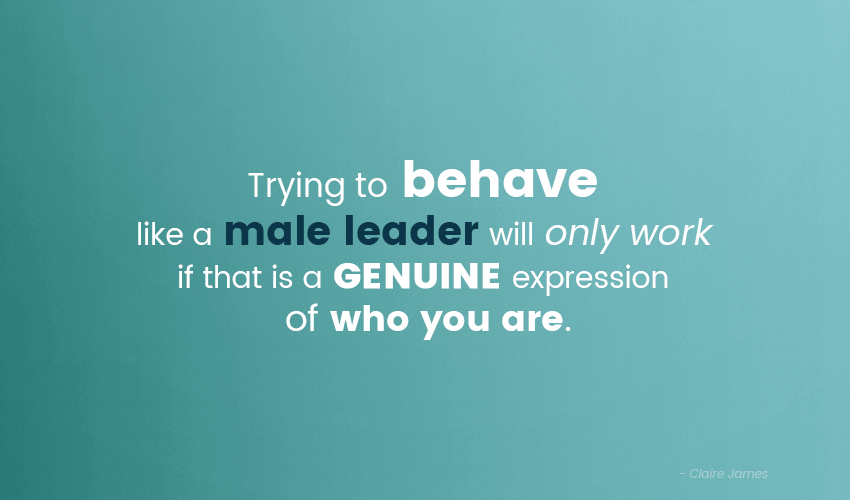
In the light of this, Paul Brown, Professor of Applied Neuroscience at Monarch Business school, and colleagues, reflect that “This points to the need for women to stay true to their own values and styles of leadership, to be authentic. Trying to behave like a male leader will only work if that is a genuine expression of who you are”. (from ‘Neuroscience for Leadership: Harnessing the Brain Gain Advantage’, Tara Swart, Kitty Chisholm and Paul Brown). This ties in with my own experience of effective leadership being about finding your own unique style and living it.

It would seem, therefore, that women would benefit from: getting clear on their strengths, skills and achievements; getting comfortable talking about them; using the power of networks; and recruiting a sponsor in the organisation to actively support their promotion (in all senses of the word!).

5) How would you briefly sum up what we know about becoming a great leader?  

Whether you’re a man or a woman, leading others is something that all personality types can potentially do well. The key to honing your leadership skills is through: cultivating self-knowledge; awareness of your patterns and where they serve or get in the way; understanding how you impact others; and seeking regular feedback and feedforward from all those with whom you interact.  

You must also act consistently upon what you discover!

This takes courage, humility and discipline (and may be facilitated by the support of a great mentor and/or coach).  However, the evidence abounds that the rewards in terms of individual, organisational and societal growth are worth every moment of inner reflection, each brave glance in the ‘feedback mirror’, and all your tiny steps, or indeed, great leaps, towards your very best self…

And there’s more! We have a bonus test to find out how great of a leader you are. Just to give you a heads up, our Teamgate CEO Marijus has completed the test and got a “True leader” result. That’s something to be proud of! Try it out yourself and let us know your results in the comments.


About the author:

claire james Claire James is Managing Director of Pivotal Moment Transitions and a developer of leaders and organisations using the power of applied neuroscience.

Pivotal Moment works UK-wide and internationally to help create audaciously successful leaders in organisations where people love to work.

For a complimentary, 45-minute leadership strategy session with Claire, please contact her by phone on 0203 239 1334 or by email at [email protected].

So this is how it starts. You created your own company, became your own boss and started to climb the ladder of financial independence. However, it is always healthy to have a reality check and consider the possible risks your business may encounter on the way. What if something goes wrong and your company fails? Do you have enough skills and stamina for it? Can you build a successful and motivated team? Do you know how to run all the different parts of your business including sales, admin, marketing, accounting and HR?

Welcome to the life of an entrepreneur where you can forget about sleep, having a personal life or your health. Although incredibly exciting, running a business can be extremely stressful not just for you but for your employees also.

We had an opportunity to speak to Billy Muir, a director of LBJ Consultants, who has over 25 years experience in dealing with HR and Employment Law issues and working with giant companies like BT. We are happy to share his insights and dig a little bit more into the stressful lives of startups and SMBs.

The reality behind the startup

Workplace stress is a burning topic nowadays, especially in the world of startups and SMBs.

“It’s no surprise that entrepreneurship can be stressful to anybody” – says Billy. “You are in charge of employing people, leading them and making decisions that will determine your business.”

One of the biggest mistakes managers do is take too much work on their shoulders: employment, HR and finances. At the same time they are juggling new customers, planning their business and marketing strategies. Other causes leading to stress is endless working hours, the high workload, research and people you have to meet. Sometimes it seems that there are not enough hours in the day to complete everything from your “to-do” list. Sounds familiar? Well, according to the Small Business Census survey conducted by instaprint, 1 in 8 business owners get so stressed that they only sleep three or four hours at night. What’s more, 50% of small business owners feel more stressed than in their previous jobs. Billy stresses the need for small companies to seek for professional help, particularly based around how to create a healthy workspace. 

Do you have a CRM that keeps you organised?

The most user-friendly CRM on the market. 14-day free trial.

Start Free Trial

Painless setup, no credit card required

Stress factors and solutions

With years of experience in HR and training, Billy points out the main stress factors that every entrepreneur should consider and ways to alleviate it.

  • Financial and employment concerns

    Staying on top of your financial paperwork, managing loans, paying monthly salary – every entrepreneur feels pressure to manage all of these things at once. As a business owner, you’ve probably invested a big chunk of money into your startup, so every decision you make can be detrimental to your business. The best solution is outsourcing your workload. For early stage startups outsourcing your HR function provides the one thing that is usually non-existent in the early days of launch – piece of mind. You might want to explore DayOneHR – a virtual HR assistant. Moving this workload to outsourced HR services can not only provide an effective solution, it can save a company money. Most importantly, give founders time to focus on the future growth of their startup.

  • Managing deadlines and responsibilities

    As a leader of your company, you are also expected to be the “boss” of your tasks and make sure everything runs smoothly. That also means that you are making decisions in every step that you take. “Have you ever heard of “decision fatigue”? It’s become a phenomenon, which can negatively affect your mental health” – says Billy. That is why it is important to learn to switch off and take some time to yourself. Plan all your week in advance to know exactly when you are working and having a day’s break. Keeping your plans in a calendar is a good habit, but don’t forget to dedicate a day for relaxation as well.

    Creating healthy workplace

  • Customers

    You cannot run a business without customers. Interaction with them either face to face or over the phone is your everyday life. In order to sustain your business and client base, it is important to maintain the relationships and provide excellent customer service. The more customers you have, the more time you have to dedicate to each of them (especially in the early business days). When it becomes too stressful to manage multiple customer requests and complaints, just sit back and think if this client is valuable to your business. Not all customers are worth retaining. If you are certain they will not negatively influence your business, go ahead and disengage with them.

How to create a healthy workspace?

Creating a positive and healthy working environment for all your employees – mission possible. Most importantly, as a manager, you have to create a clear job description so that your employee knows what is required and what is their role. It‘s not that easy with startups where their job description changes every 10-12 weeks.

“Getting the right people and building healthy relationships with them – this is what leads business to success” – says Billy.

When the employees know what is expected from them and are not afraid to ask for help, work becomes more friendly and enjoyable place to be. It is crucial for a manager to acknowledge employees as individuals, who have good and bad days, who have their personal lives and struggle with everyday problems.

How often should you praise your team? 

Did you know that only 28% of employees are satisfied with overall company culture, i.e. work ethics, values, etc.? Employees do not feel appreciated for their time and efforts. This is due to the lack of communication with the team and managers.

Billy suggests having a meeting at least once a month with your employees where you are going through what they have done really well and the areas of improvement. Don’t forget another important thing – training, training and more training. Once your staff is trained, they’ll know all aspects of their job and the level they should be at.

“That brings us to the planning stage, where you have to set goals for each team member” – he adds.

The key to employee job satisfaction is simple. Make them feel needed, set realistic goals and tasks, leave fields for improvement and praise them for their good work. Receiving praise is empowering, it increases productivity and motivation and it costs nothing.

“At the end of the day,  people should be experts on making their business a success and make it grow” – says Billy. Therefore, making sure you have the right people to work with leads your business to success and less stress.

As any other startup company, here at Teamgate we completely understand the struggles that come from a high workload. Sometimes stress, pressure and fatigue dawns at you all at once and it is difficult to stay positive and motivated every day. We agree with Billy that being organised, planning your work and rest days can help relieve stress and start the day with a more positive note. Have you experienced stress at your company? What helped you to deal with it and overcome it?


Billy has over 25 years experience in dealing with HR and Employment Law issues. He is currently a Lay member of the Employment Tribunal Panel in Glasgow. You can contact Billy through his TwitterFacebook or LinkedIn